Home/Capabilities/Aluminum Dip Brazing

Aluminum Dip Brazing

Braze an entire assembly in a single operation — producing leak-tight, EMI-shielded joints across varying material thicknesses, with minimal distortion.

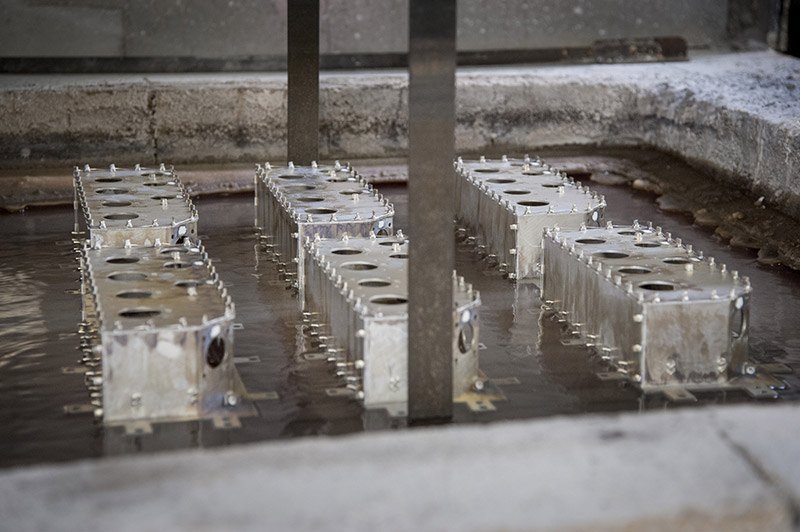
Brazed aluminum assemblies emerging from the dip brazing salt bath

Process Overview

The dip brazing process allows simultaneous joining of multiple joints with varying material thicknesses. The resultant joints are leak-tight and EMI shielded. As the parts are uniformly heated with minimum fixturing, only minor distortion results — easily managed with proper tolerancing and design.

Parts are cleaned of excess oxides, then assembled with the proper filler metal applied. At Mech-Tronics, we use our in-house photo chemical etching process to make custom brazing shims, yielding excellent control over excess filler-metal flow. Parts are placed on stainless steel fixtures, heated to 985°F in a pre-heat furnace, then immersed in a bath of molten salt (1100°F) containing flux. The molten bath transfers heat evenly, supports the assembly, and fluxes the joints. Immersion is generally less than two minutes, during which filler metal melts and flows to all joints by capillary action. The assembly is then removed, cooled, and cleaned — ready for further processing.

Typical Aluminum Dip Brazing Process

  1. Clean & assemble. Clean the component parts, complete any subassembly work, then assemble with brazing shims at lap joints (.187 or greater) using slots and tabs, tack/spot welds, aluminum screws, rivets, or staking.
  2. Apply filler & fixture. Verify dimensions, apply filler-metal paste to all joints, and load onto the brazing fixture.
  3. Preheat & braze. Preheat at 985°F, then immerse in the 1100°F salt bath at a constant rate so filler metal flows to every joint with minimal distortion.
  4. Remove & quench. Withdraw the assembly allowing for flux drainage, then move to the quenching area to cool.
  5. Clean & finish. Remove from the fixture, clean off flux residue, grind construction aids, and straighten as needed.
  6. Age harden & inspect. Age harden at 350°F for 8–10 hours, then perform final inspection of the braze joints.
Benefits

Advantages of Dip Brazing

Reduced Tooling Cost

Uses little if any specialized tooling; common fixtures allow quick, inexpensive configuration changes.

Material Savings

Unlike castings or machined parts, dip brazing can be done at near-net size.

Improved Structural Integrity

A continuous leak-tight, EMI-shielded joint even across a variety of material thicknesses.

Better Conductivity

An aluminum joint conducts better than adhesive-bonded or mechanically attached assemblies.

Less Distortion

Uniform heating yields less distortion than a welded part.

Design Freedom

Engineers enjoy a greater range of design options — and reduced design-change cost and implementation time.

Design Considerations

  • Design components to be self-fixturing and self-locating. Aluminum's rate of expansion is about 1/3 greater than the fixturing material, so fixturing is kept simple and minimal.
  • Some distortion will be present. Aluminum reaches annealed condition at brazing temperatures. Parts are quenched immediately; some straightening can improve distortion. Closely toleranced features may need to be machined after brazing.
  • Parts must be vented. Dense brazing salts make aluminum buoyant, dictating specific fixturing orientation. Vent holes may be required and can be welded closed afterward. No closed cavity can be present due to pressure from expanding gases.
  • Filler metal comes in different forms: .003 thick shim, paste (powder mixed with water), and wire of varying diameters / clad brazing sheet.
  • Joint clearance must be controlled. Dip brazing depends on capillary action created by proper joint clearance (general guidelines below).

Suggested Joint Clearance

Joint Width (in.)Joint Width (mm)Suggested Clearance (in.)Suggested Clearance (mm)
< 0.188< 4.760.002–0.0040.05–0.10
> 0.187> 4.750.004–0.0060.05–0.15

When clad brazing sheet is used, the clad side must be in direct contact with the mating part. Please consult us if you are designing your own components for dip brazing.

Materials

Brazeable Aluminum Alloys

TypeAlloysNotes
Wrought6061, 6062, 6063
Wrought6951Clad brazing sheet
Wrought1100, 3003Non heat-treatable alloys
Castings710, 711, 712, 713

Composition of Clad Aluminum Brazing Sheet

DesignationSides CladCore AlloyCladding AlloyNominal Cladding Thickness / Side
No. 1113003434310% for .063 and less; 5% for .064 and more
No. 1223003434310% for .063 and less; 5% for .064 and more
No. 2116951434310% for .090 and less; 5% for .091 and more
No. 2226951434310% for .090 and less; 5% for .091 and more
Request a Quote